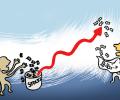
In absolute terms, the year closed with the market capitalisation of all BSE-listed companies rising by Rs 45.5 lakh crore to Rs 152 lakh crore, or an increase of 42.8 per cent, compared to the closing value on December 30, 2016, says Pavan Burugula.

Private corporate spending, which had touched 16 per cent of GDP in recent years, had played a key role in India posting 9 per cent growth in the last three years till March 2008. If there's a sharp decline in this, companies fear it will hurt demand. Indeed, some like JSW Steel joint MD Seshagiri Rao fear that things may worsen from here unless people are able to raise money and start investing again. Banks say both current accounts and credit off-take remains subdued.

SBI was the top loser in the Sensex pack, shedding around 3 per cent, followed by Kotak Bank, IndusInd Bank, NTPC, ICICI Bank, Axis Bank and HDFC Bank. On the other hand, HUL, ITC, L&T, Bajaj Finserv and Tech Mahindra ended with gains.
The 30-share index has lost 4,097.51 points in seven sessions since January 14. It was down as much as 5,874.35 points from its life-time high of 21,206.77 points, scaled on January 10, when it touched an intra-day low of 15,332.42 points on Tuesday. The Sensex had first touched this level on July 16, soon after it crossed the 15,000 level on July 6.

It is best not to get carried away by returns or take a short-term view of the markets, says Bhavana Acharya.

Some make for good investment ideas even after a strong run-up but others could see gains fizzling.
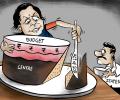
Every option before the finance minister comes with a price tag, observes T N Ninan.

'Internet, healthcare and life insurance are a few sectors which offer solid long-term decadal potential.'

MMFS is looking at a compounded annual growth rate (CAGR) of 18 per cent in assets under management (AUM) during FY23 to FY26 on the back of the strong recovery. The company has initiated risk-mitigating initiatives, including diversification into non-vehicle loans, building digital capacity and re-classification of customer profiles into affluent and mass-affluent in semi-urban segments to better target marketing.

L&T was the top loser in the Sensex pack, dropping 4.99 per cent, after the engineering major posted a 45 per cent decline in consolidated net profit for the September quarter. Titan, ONGC, Axis Bank, HUL, NTPC, M&M and HDFC were the other major laggards, shedding up to 3.32 per cent. NSE Nifty fell 58.80 points or 0.50 per cent to 11,670.80.

The Budget has to provide for capex on roads, railways, defence and other infrastructure sectors.

Even before NCP-Ajit Pawar leaders came to meet in Delhi, the central government decided to buy 200,000 tonnes of onions from farmers at Rs 24.1 per quintal. This was among the highest prices at which onions have ever been bought from farmers.

Equity benchmarks shrugged off lacklustre global cues to clock smart gains on Tuesday, buoyed by strong buying interest in index heavyweights Reliance Industries and HDFC twins. However, a depreciating rupee and unabated foreign fund outflows capped the gains, traders said. The 30-share BSE Sensex rallied 562.75 points or 0.94 per cent to settle at 60,655.72.

There has also been some easing of norms, allowing foreign direct investment to come into relatively small projects of 20,000 sq metres.

Given the volatility of the global marketplace, India is already on a strong wicket and well poised to provide a lucrative option to foreign investors.

With a rise of around 30 per cent in the benchmark index S&P BSE Sensex, 2014 has been the best year for Indian equity markets since 2009, when the benchmark index surged 81 per cent.

Tata Steel was the top gainer in the Sensex pack, jumping around 4 per cent, followed by NTPC, PowerGrid, Reliance Industries and Bajaj Finserv.

'India has many attractive features for the long-term investor; it combines: A low per capita income, a young population, and a heavier presence of high margin, asset-light firms in the technology sector.'

While domestic market growth is important, the sales trajectory in the international markets, which account for 45 per cent of the revenues, will be a key rerating trigger, say analysts.
On a weekly basis, the Sensex climbed 749.86 points or 2.69 per cent and the NSE Nifty soared 237.10 points or 2.76 per cent

Leading stock exchanges BSE and NSE have put out comprehensive guidelines for handling technical glitches at members' end in order to prevent disruptions. Under the new framework, members will have to pay Rs 20,000 per day in case of failure to report the incident to the exchanges within the required timeline, BSE and NSE said in separate circulars. The guidelines outline technology infrastructure and system requirements that a member should put in place to prevent any incident of business disruption resulting from technical glitches.

Tech Mahindra was the top gainer in the Sensex pack, rising over 3 per cent, followed by Dr Reddy's, PowerGrid, Kotak Bank, Sun Pharma, ICICI Bank and M&M. On the other hand, IndusInd Bank, Asian Paints, Maruti and Bharti Airtel were among the laggards.

Titan posted better than expected revenue growth in the March quarter of the financial year 2022-23 (Q4FY23), powered by strong demand trends in the jewellery and watch segment. Standalone jewellery sales for the firm were up 24 per cent year-on-year (YoY) on a slightly lower base and aided by like-to-like growth of 19 per cent. The company highlighted that new buyer growth was at 15 per cent while average ticket size was up 8 per cent.

Consumption of gold is the highest among middle-income households - those with annual income between Rs 2 lakh and Rs 10 lakh - who account for an average of 56 per cent of gold sales over the last five years, according to a nationwide survey conducted by India Gold Policy Centre (IGPC) at the Indian Institute of Management, Ahmedabad (IIM-A). "Per capita consumption is highest among the rich, but total volume still rests with the middle-income group. "With increasing income, there is an increasing propensity to consume gold, although the share of gold in the portfolio does not increase with the same proportion of income," the survey report says.

Most immediately, he pledged to move slowly if needed in winding down an oil window that provides dollars directly to state-run oil companies

The IT industry advisories show that they think they've weathered the worst, observes Devangshu Datta.

Equity investors grew richer by Rs 32.49 lakh crore in 2020 on the back of smart returns in the stock market which had a roller-coaster ride during the year hit by the coronavirus pandemic. The COVID-19 outbreak ravaged lives and livelihoods on a global scale, shuttering businesses and jolting world equities. But amid all the gloom, Indian stock indices gave hope of returning to winning ways towards the latter part of the year.
Markets are poised for excellent growth, provided reforms continue to roll

Brokerages have cut their estimates of listed diagnostics players for the financial year 2023-24 (FY24) after mixed December quarter results and muted near-term outlook. Their volumes and realisations will be under pressure due to weakness in Covid-adjusted performance and higher competitive pressures, the brokerages believe. In a post-Q3 results note on Dr Lal Pathlabs, Bhavesh Gandhi of YES Securities pointed out that there has been a lack of volume revival in recent quarters, with an increasing likelihood that FY24 too would be a work-in-progress year for the company's initiatives to bear fruit.


Tata Steel was the top gainer in the Sensex pack, rising 3.10 per cent, followed by Bajaj Finance, Bajaj Finserv, Reliance Industries, Asian Paints and Titan.

IndusInd Bank, L&T, ITC, HUL, Reliance Industries and Sun Pharma were among the gainers. On the other hand, HCL Tech, Axis Bank, Asian Paints, UltraTech Cement and Infosys were among the laggards.

For the week, the Sensex recorded a gain of 131.39 points, or 0.38 per cent; while Nifty gained 38.75 points, or 0.37 per cent.

Good performances by most information technology (IT) companies in the September quarter and improved forecasts notwithstanding, with the exception of Infosys, stocks of IT biggies such as TCS, Wipro and HCL Technologies have fallen three to nine per cent since Infosys announced its earnings on October 11.

'Markets are likely to remain choppy for the next 6 months.'

But much depends on govt action & global economy; Sensex gains in 2070 the biggest in five years

India may be at the fag end of a downcycle that has lasted over 7 years
In 1991, during the balance of payments crisis, it was an even-money bet that India would become a basket case. In hindsight, it was a great entry-point for investments because the economy made a spectacular recovery. But nobody could have been sure about the turnaround.

Capital goods shares continued to trade firm in late noon despite weak market trend on the back of encouraging core sector growth in February.

In the past 12 months, since September 2020, the net cumulative increase in employment has been just 44,483. This is negligible -- just 0.04 million on a base of over 400 million jobs, reveals Mahesh Vyas.
 © 2026 Rediff.com - Advertise with us - Disclaimer - Privacy Policy - Sitemap - Feedback - About us - Terms of use - Grievances